
K-pop Demon Hunter and the Female Hero’s Journey. Why This Hits So Hard.

Maureen Murdock developed the Heroine’s Journey as a counterpoint to Joseph Campbell’s Hero with a Thousand Faces. When Murdock asked Campbell about women in the Hero’s Journey, he famously replied:
“Women don’t need to make the journey. In the whole mythological tradition, the woman is [already] there. All she has to do is to realize that she’s the place that people are trying to get to.”
This dismissal inspired Murdock, a trained psychologist, to explore myth and psychoanalysis more deeply. Her result was an archetypal pattern that centers a woman’s quest for healing and wholeness: the Heroine’s Journey.

When you hear “the hero’s journey,” you might picture epic fantasy quests—think Lord of the Rings or Star Wars. The formula is pretty classic: a hero leaves home, fights monsters, defeats a big villain, and returns stronger than before. That version of the story, often called the male hero’s journey, is about conquest and external battles.
But what about stories where the biggest battle is inside the hero? That’s where the female hero’s journey comes in. Instead of proving strength through domination, it’s about reconciling identity, healing old wounds, and becoming whole again.
K-pop Demon Hunter works because it gives us a heroine whose battles mirror real struggles: the pressure to be flawless, the cost of hiding vulnerability, and the courage it takes to reclaim wholeness.
It’s not just about fighting demons—it’s about healing the fractures that make us feel less than whole. And in the end, that’s what makes Rumi’s journey so powerful.
She doesn’t just slay monsters. She shows us what real strength looks like: becoming unapologetically yourself.
That’s exactly why K-pop Demon Hunter feels so fresh. Sure, it has demons, action, and high-stakes battles—but the real power of the story lies in how its heroine grows. She isn’t just fighting evil; she’s fighting to reclaim herself.
The Male Hero’s Journey: The Classic Blueprint
In the traditional version, the hero:
Gets “the call to adventure.”
Faces enemies and overcomes obstacles.
Survives a near-fatal trial.
Returns home triumphant, bringing back some kind of prize or victory.
It’s the story of slaying dragons, conquering empires, or saving the world. Powerful, but pretty straightforward.
The Female Hero’s Journey: A Different Kind of Quest
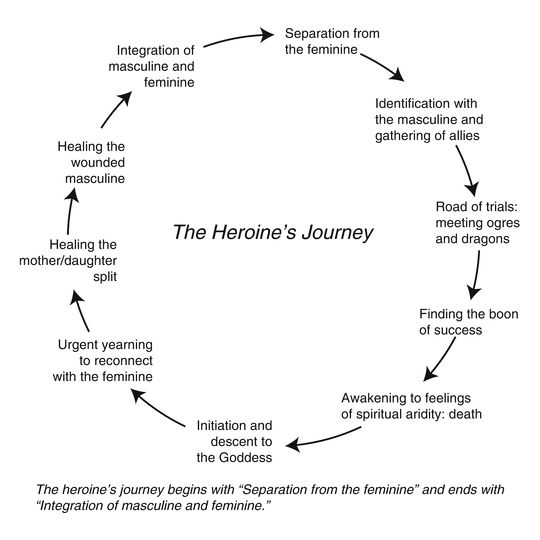
The female hero’s journey takes a different path. Instead of focusing only on external conquest, it digs into what happens when the heroine has to reject parts of herself to survive, and how she eventually reclaims them. It’s about:
Leaving behind vulnerability or “softness” to succeed in a demanding world.
Learning toughness, often at a cost.
Hitting a breaking point where the old way no longer works.
Finding healing and wholeness by embracing all parts of herself.
The victory isn’t just beating the bad guy. It’s returning stronger because she’s finally complete.
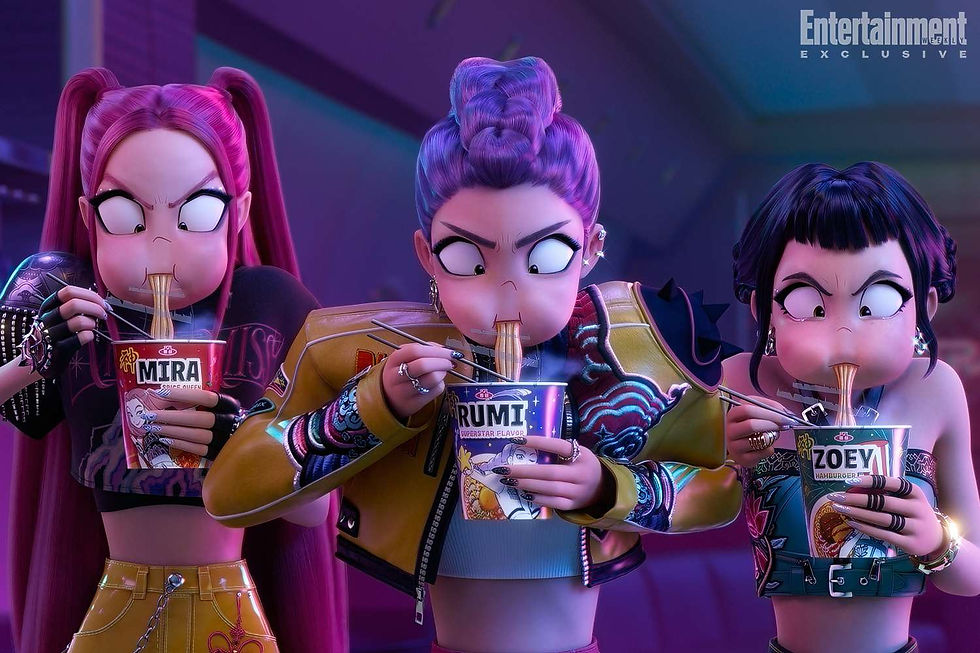
K-pop Demon Hunter and the Heroine’s Journey
Rejecting the Feminine
Rumi, Mira, and Zoey—idols in the group Huntr/x—open the story preparing for a concert. On the surface, it’s all ritual, beauty standards, and polished image. Beneath that, they carry a secret: they fight demons with their music. Their ultimate goal? To create the Golden Honmoon—a final seal that would banish demons from the human world permanently.For Rumi, survival means suppressing vulnerability. Fear, exhaustion, and softness have no place in idol culture or demon hunting.
We as the viewers see a perfect cohesive group. But Rumi has secret….something she hasn’t even told her closest friends.
This rejection of the feminine echoes the Heroine’s first step: abandoning vulnerability to survive in a hyper-masculine system of competition and performance.
Identification with the Masculine
“We are hunters, voice strong, your faults and fears must never be seen.”
As a demon hunter, Rumi adopts toughness and discipline. She learns to weaponize strength and secrecy. Outwardly, she is the “perfect soldier.” Inwardly, she’s fractured, hiding truths even from her closest allies. Her strength is armor, not authenticity. When her two band mates, Zoey and Mria want to relax on the couch. Rumi pushes the button on their secret song. She isn’t ready to relax, she needs to keep going.
And she is so close.
Road of trials meeting ogres and dragons.
The heroine encounters trials and meets people who try to dissuade the heroine from pursuing their chosen path, or who try to destroy the heroine.

Her battles against demons become increasingly symbolic. The demons are real, but they also stand in for exploitation, perfectionism, and the relentless dehumanization of fame. Every fight chips away at the illusion that she can win by playing the game the way the system demands.
When Jinu (a demon boy band member) see’s the secret Rumi is hiding he doesn’t expose her. Instead, he helps her cover it up. Furthering her lie and her inability to accept herself. But let’s be honest it was also very meet cute!
This is where the female hero’s journey diverges most sharply from the male one. While a male hero would simply level up and slay bigger monsters, the heroine realizes that no amount of conquest will heal the deeper wound.
No amount of victory will fix the fracture inside her.
Boon of success

Having overcome her trials, the heroine attains a measure of success, a powerful title, position, or wealth. She is a superwoman who has it all. Imposter syndrome still sneaks in, and she wonders when she will feel she has truly succeeded.
The girls release their latest track, Golden. This is supposed to be the eventual catalyst for the golden Honmoon.
The track is an instant success!
But Demons have a plan to fight back.
Cue Saja Boys.
Spiritual Death
At her lowest point, Rumi faces a breakdown—not just physically, but emotionally and spiritually. This “dark night of the soul” isn’t about whether she can fight one more battle, but whether she can even live with the fractures in her identity.
Rumi tries to sing Golden for a live performance but her voice keeps cracking. She leaves the stage only to find that the patterns have grown over her throat.
Her voice, the one thing that was supposed to save her, and is no longer working like it should. This is because she is still hiding a part of herself.
The girls get together and form a plan to take down Jinu and his band the, Saja Boys. Things click right away and the three of them lay down an epic dis-track. Except this track is about hating demons and their marks…..
Initiation and Decent to the Goddess (this is also the midpoint break or mirror moment)
The heroine faces a crisis of some sort in which the new way of life is insufficient, and the heroine falls into despair
Rumi and Jinu form a real connection, meanwhile Rumi’s relationship with Zoey and Mira is more strained than ever. Her closest friends do not understand why Rumi doesn’t like their anti-demon song and Rumi still hasn’t come clean about her patterns. During practice they see a disturbance in the Hamu and the three of them descend into a literal train tunnel. They then proceed to fight the largest tear in the Honmoon that they have even seen.
Thousands of Demons escape hell. They fight their hardest but it still isn’t good enough. They lose all the passengers on the train. Zoey and Mira fight with Rumi, they don’t understand her and they can tell something isn’t right.
Mirror moment—Everything is topsy turvey from here on out. Where we started with Rumi hating demons and killing them on sight. We now have a Rumi who is actively seeking out a demon’s company. We also started with three best friends, but now we see a split starting to form.
Will Rumi learn to love herself before it’s too late?
Urgent Yearning to reconnect:
The heroine wants to, but is unable to return to their initial limited state/position.
Rumi meets up with Jinu and they hatch a plan to work together. We are starting to see

Rumi accept that not all demons are bad, and even look to one for help.
Rumi also has a heart to heart with Zoey and Mira. She is still trying to fix things the wrong way. Even though she sees that not at demons are bad, she is still unwilling to admit her flaw, despite the fact that her female counter parts are admitting theirs.
She hasn't learned to trust.
Her goal is to close the Honmoon, not accept herself.
Healing the mother daughter split:
The heroine reclaims some of their initial values, skills, or attributes (or those of others like them) but now views these traits from a new perspective.
Rumi literally goes to speak with the mother figure in her life. She tells her that she wants to be accepted. But she is told again that she needs to hide.
Except this time, Rumi doesn’t listen. She sees another way.
If hiding herself is what it takes to heal the world, she doesn’t want any part in that path and instead she forges a new one.
Healing the wounded Masculine
The heroine makes peace with the “masculine” approach to the world as it applies to them.
Rumi shows up at the final showdown, fully herself. She sings, but this time she shows her patterns.
Rumi admits she tried to hide them and apologizes for not trusting her friends. She still is willing to fight the demons, but now she does it as fully herself.
Mira, Zoey and Rumi break into an epic song that captured millions.
Nothing but the truth now. Nothing but the proof of what I am. The worst of what I came from, patterns I'm ashamed of. Things that even I don't understand. I tried to fix it, I tried to fight it. My head was twisted, my heart divided. My lies all collided. I don't know why I didn't trust you to be on my side
I broke into a million pieces, and I can't go back. But now I'm seeing all the beauty in the broken glass. The scars are part of me, darkness and harmony. My voice without the lies, this is what it sounds like. Why did I cover up the colors stuck inside my head?I should've let the jagged edges meet the light instead. Show me what's underneath, I'll find your harmony. The song we couldn't write, this is what it sounds like
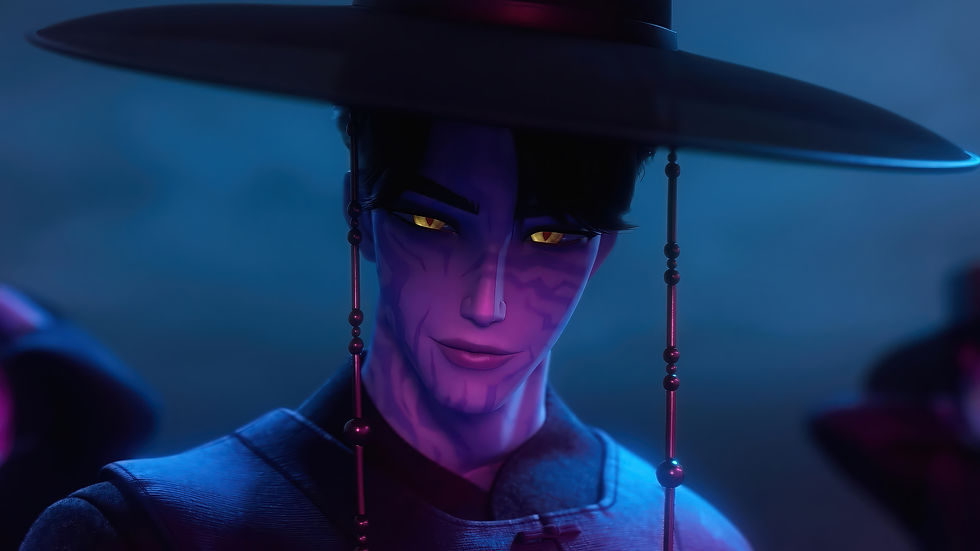
This is also the scene where Jinu sacrifices himself to save Rumi. Healing the masculine parts of himself and fully accepting his shame. Juni is also on a heroine journey. The hero
and the Heroine's journey is not gender specific but rather a way to describe two different myth structures.
Choosing Wholeness
Our heroine has come full circle. Male and female aspects of her personality are integrated in a union of ego and self. She is whole and capable of genuine love for others. She remembers her true nature.
Her turning point doesn’t come in combat—it comes in confession. She admits to an ally that she’s terrified, that she feels lost. Instead of making her weaker, this honesty becomes her strength. She learns she doesn’t have to choose between being strong and being vulnerable. She can be both.
We are shown an ending scene where the three girls are in a bathhouse. A place where Mira and Zoey always wanted Rumi to go, but she couldn’t because she was hiding her colors.
Returning Whole
In order to face the world/future with a new understanding of themselves and the world/life, the heroine integrates the “masculine” and “feminine” qualities/perspectives. This permits the heroine to see through binaries and to interact with a complex world that includes the heroine but is also larger than their personal lifetime or their geographical/cultural expectations.
When she returns to the stage, it’s not about perfection anymore. It’s about authenticity. And that’s the victory she brings back to her world.
This is also the point where the Male MC is healed and sacrifices himself for the greater good. I could write an additional blog on how the MMC goes through his own heroines journey, as the path is not gender specific and males and female can go on a hero or heroine's journey.

Why This Hits So Hard
K-pop Demon Hunter works because it gives us a heroine whose battles mirror real struggles: the pressure to be flawless, the cost of hiding vulnerability, and the courage it takes to reclaim wholeness.
It’s not just about fighting demons—it’s about healing the fractures that make us feel less than whole. And in the end, that’s what makes Ji-woo’s journey so powerful.
She doesn’t just slay monsters. She shows us what real strength looks like: becoming unapologetically yourself.
Some information was pulled from these two articles,


Comments